Dirasat (KFCRIS Papers)

Number: 89/90
Author: Prof. Dr. Abdul Malik Salaatnia
This topic falls within the activities of the International Symposium on Desert Culture, which explores the cultural and heritage history of the Arabian Desert. At first glance, one can see that this field of study is vast and encompasses various aspects of human life that have shaped civilizations over history, influenced by climatic and economic conditions, and defined by societal norms shaped by the necessities of survival. Through our examination, we have constructed a model of life whose impacts are still felt today. Covering more than two million square kilometers, or 4/5 of the total area, the Algerian Sahara has been significantly shaped by human activity for mil

Number: 87/88
Author: Dr Abdullah H. Masry and Dr Martina Renzi
This study focuses on the analysis of the southwestern region of the Arabian Peninsula, which has been less thoroughly investigated compared to other areas of Arabia. Present-day Southwest Arabia is politically divided between parts of Saudi Arabia (the regions of Asir and Najran), Yemen, and a small portion of Oman (Dhofar). The Rub’ al Khali desert, also known as the Empty Quarter, serves as a geographical and cultural barrier between the northern and southern regions.

Number: 85/86
Author: Qasim ibn Khalaf Al-Ruways
From a national cultural perspective, this paper seeks to introduce one of the prominent anthropologists, a serious academic who made society his field and the desert his destination to rain down on the popular memory before the demise of the pre-oil generations. He gathered scattered fragments that were on the verge of disappearing and studied them using modern scientific methods, probing their depths with a sensitivity that made him a global reference in this regard. It is an extended reading over the timeline of Saad Al-Sowayan’s life, starting with his personal and intellectual background, then moving on to the challenges and achie

Number: 83/84
Author: Dr. Heba Albeity
This research asserts that, for Al-Thubaytī, the desert transcended its mere geographical existence. It ebbed and flowed through his verses as a sentient being, perpetually in motion, seeking its essence within the poet’s words and anticipating the reverberations of his verse. While the desert resided within the very fabric of his writings, it also trailed behind him, the grains of its sands refining his every stride: “I arrived hastily, with the desert trailing me; the script of the sand weaving through my footfalls.” The poet’s creation of this imaginary desert serves as implicit evidence of the profound existential alien

Number: 81/82
Author: Dr. Awad Al-Qurashi and Dr. Abdullah Al-Zubaidi
One of the striking aspects of the Arabian desert culture is the fascination with and captivation by encryption and coding in human communication, both verbal and non-verbal. In certain contexts, people use indirect symbols to convey requests, reprimands, challenges, tests, or other forms of social interaction. For example, in Arabian tradition, a guest’s refusal to drink the first cup of coffee offered is understood as an implicit sign of a request or as a subtle expression of reproach. In contrast, serving a cup beyond its customary limit is often perceived as an implicit sign of disrespect or a diminished sense of esteem. Likewise, certain
Number: 79/80
Author: Solaiman al-Theeb
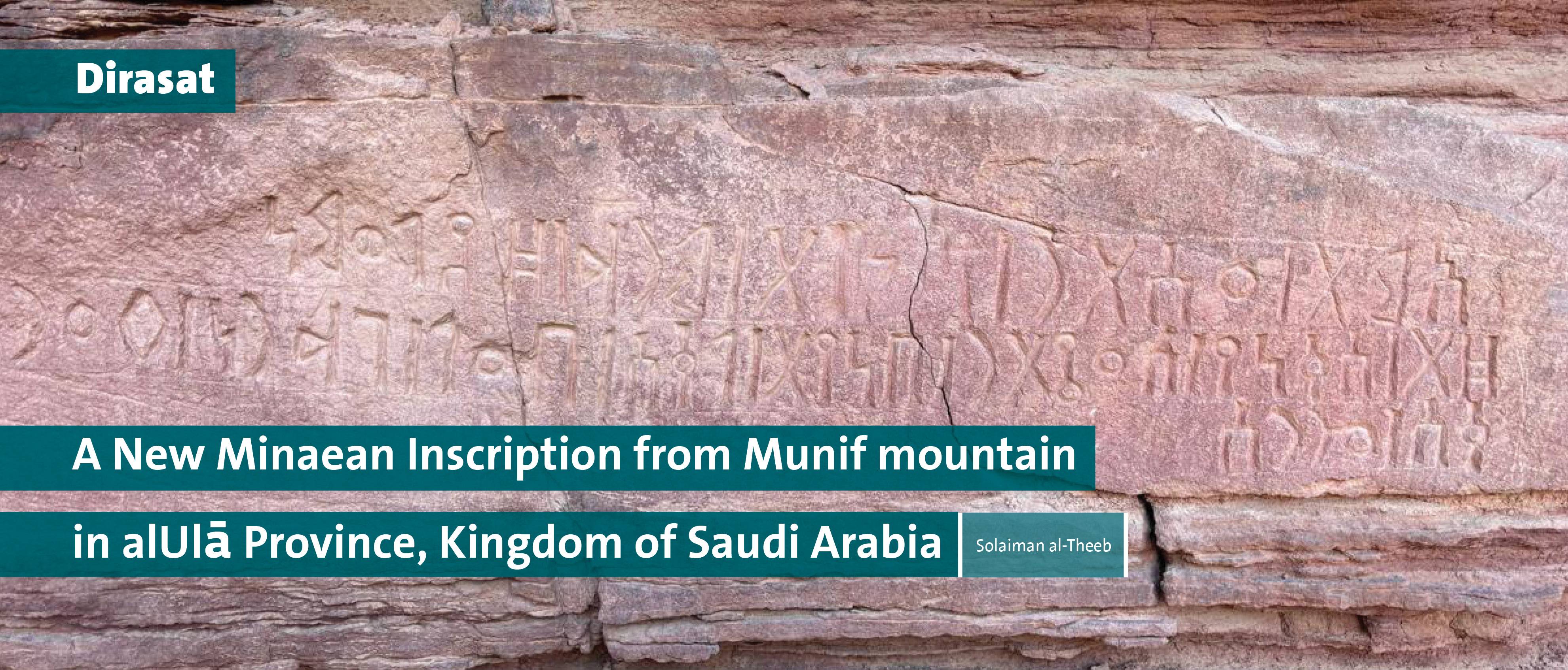
This inscription, discovered by Mr. Ahmed son of Mohammed al-Masuod during his visit to Abdulrahim al-Suqayr’s farm, is carved in relief on one of the rock faces of a mountain locally known as “Zib Munif,” located in the north of the Old Town of AlCulā which is about 4 kilometers. The writing technique reflects the skill and linguistic proficiency of the author in South Arabian script and language. If we consider the use of the letter “s” at the beginning of the verb (sqny) and at the end of names (Crrs) as a third-person singular pronoun, it shows a proof that indicates the Minaean dialect.
Number: 77
Author: Michael Christopher Low
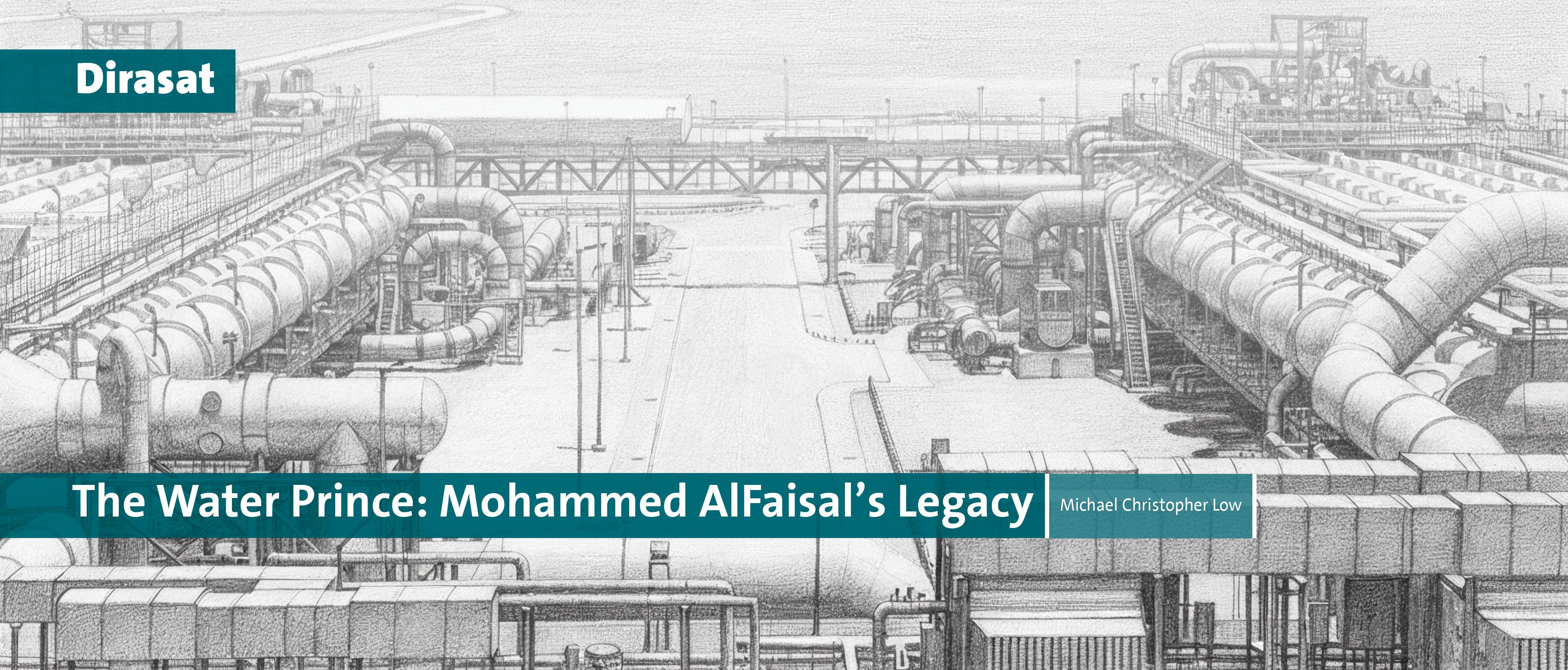
It is an undisputed truism that the story of twentieth-century Saudi Arabia is synonymous with oil. And while oil and gas pipelines have rightfully been understood as the infrastructural lifeblood of the Kingdom’s meteoric rise, another set of pipelines and processing plants has remained virtually invisible to historians, desalination facilities. Despite this seeming invisibility, Saudi Arabia has become the world’s leading desalination superpower. Thus, instead of thinking of Saudi Arabia only as a petro-state, this article argues that we also need to understand the Kingdom as a desalination powerho

Number: 74
Author: Dr. Manuel Schubert, Dr. Mohammad Alhajji, Mohammed Al-Kabour, Dr. Ali Alhakami, Ruba Al-Yousefi, Dr. Monerah Almahmoud, Dr. Camellia Alibrahim, Ahmad Angawi, Wiam Hasanain, Dr. Olayan Alharbi, Chaza Abou Daher, May Al-Baz, and Daniel Ahrndsen
Over the past decade, Behavioral Insights (BI) have proven to be a powerful tool for enhancing policy effectiveness worldwide. An active BI community in Saudi Arabia has leveraged these insights across various policy sectors. This paper explores how Vision 2030 – one of the world’s most ambitious behavioral change programs – can further benefit from the systematic use of Behavioral Insights in policy design and evaluation, focusing on education programs and human capability development.
The paper offers a structured approach

Number: 73
Author: Francesco Calzolaio
The vizier and scholar Rashīd al-Dīn al-Hamadani (d. 1318) is a towering figure in Islamic intellectual history. His impressive scholarly output spans several fields and rivals that of the most illustrious Islamic thinkers in terms of depth, sophistication, and impact. Relative to his importance, however, scholarship about him is fairly limited. This is beginning to change, as in recent years monographs that explore his intellectual contributions in a number of key areas have begun to appear. Until now, however, very little scholarship has treated one of the most original areas of his scholarly production: the study
2024-10-06
| Histories of Sinophone Islam in Macau: A Tapestry of a Multi-ethnic Muslim Community
72
2024-10-06
| Histories of Sinophone Islam in Macau: A Tapestry of a Multi-ethnic Muslim Community
72

Number: 72
Author: Hung Tak Wai
Since the fifteenth century, Macau has enjoyed the status of being one of the major entrepots of international commerce in Asia. Despite the historic and deeply rooted involvement of Muslims in inter-Asian maritime trade, however, historians have rarely acknowledged the longstanding history of the Muslim community there. The absence of a detailed study of Macau’s Islamic community probably stems from the prevalence of the Portuguese and, therefore, Catholic colonial presence and its associated legacy of religious intolerance. The surprising thing is that it was the Europeans themselves who brought Islam to this enclave: Macau’s only mosque and Muslim cemetery, together known a