Alfaisal Magazine celebrated Its golden jubilee: fifty years of shaping cultural awareness
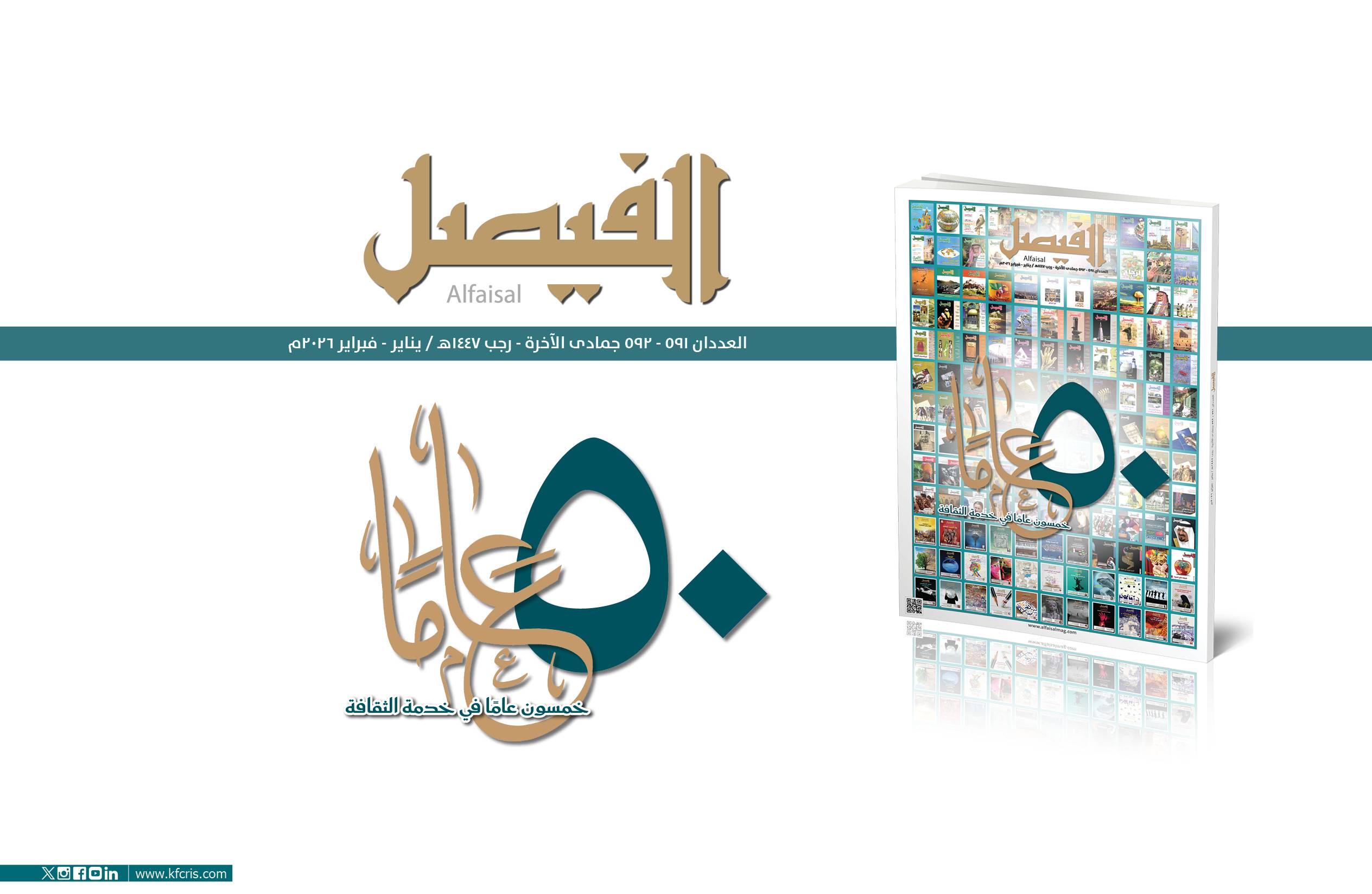
The latest issue of Alfaisal Magazine, published by the King Faisal Center for Research and Islamic Studies, has been released for the months of January–February 2026. This issue comes within a special celebratory context marking fifty years since the magazine’s founding, which began with its first publication in 1397 AH (1977). The occasion serves as a moment to revisit Al-Faisal’s journey as one of the most prominent Arab cultural projects that has maintained its presence and continuity across decades of intellectual and media transformations.
This issue affirms that celebrating the golden jubilee is not limited to recalling memory or documenting the past; rather, it extends to a conscious reading of the magazine’s trajectory, its position within the Arab cultural landscape, and its role in accompanying the major questions that have preoccupied contemporary Arab thought from the 1970s to the present day. This has been achieved through a clear editorial commitment to a balanced approach that combines intellectual depth with critical openness.
The content of the issue reflects a central concern with intellectual and cultural questions that dominate public debate in the Arab world. The published materials address themes such as freedom and the limits of creativity, transformations in philosophical thought, and the complexities of the relationship between heritage and modernity. They also explore issues of identity and language, women, justice, and the role of culture in an era of rapid change. These topics are presented through careful analytical approaches that avoid declarative discourse or ready-made judgments, seeking instead to deconstruct cultural and social phenomena within their historical and intellectual contexts, and to connect them with the pressing questions imposed by Arab and global realities.
The issue also demonstrates a clear interest in questioning the position of the intellectual today, the role of critical thought in confronting simplification and polarization, and the limits of cultural discourse in an age dominated by digital media and accelerated knowledge flows. Several contributions examine the future of creativity amid technological transformations, as well as the impact of new media on modes of reception and on the relationship between writer and reader, and between culture, elites, and the wider public.
In addition, the issue includes in-depth cultural readings of Arab and international intellectual and literary experiences, alongside interviews with thinkers and writers, and materials addressing the arts, theater, and cinema. It also features creative texts, translations, and cultural portraits, reflecting the breadth of the intellectual horizon that Al-Faisal has consistently sought to establish as a defining feature of its cultural project. This diversity aligns with an editorial vision that views the magazine as a shared space for productive difference, a platform for dialogue among intellectual currents, and a field for the intersection of experiences and perspectives—without compromising the scholarly and linguistic standards that have distinguished the magazine since its founding.
The golden jubilee is present throughout the issue as a moment of reflection on the magazine’s cultural experience. The editorial vision emphasizes that Al-Faisal has never been a transient project or a temporary response to circumstance, but rather a cultural platform founded on belief in the value of the written word, the responsibility of discourse, and respect for the reader’s intellect. This vision notes that the magazine has succeeded in preserving its stature despite the radical transformations witnessed in the media landscape and the dominance of digital platforms, through developing its tools, providing an electronic edition, and opening its complete archive as an important reference for researchers and those interested in the history of Arab cultural journalism.
The issue also presents selected materials from previous editions published over past decades, as a conscious attempt to enable readers to trace the magazine’s stages of development and to observe transformations in its cultural and intellectual discourse—considering this an essential part of reading the present and understanding its paths, rather than merely recalling the past.
In this way, the new issue of Alfaisal Magazine offers a mature cultural celebration of its golden jubilee—one that goes beyond commemorating memory or enumerating achievements. It reaffirms the continuity of the magazine’s cultural mission and renews its commitment to its role as a platform for serious intellectual endeavors, a space for responsible dialogue, and a thoughtful cultural voice in an era marked by accelerating transformations and competing discourses.