KFCRIS hosts the 13th edition of Arabic Manuscript Day

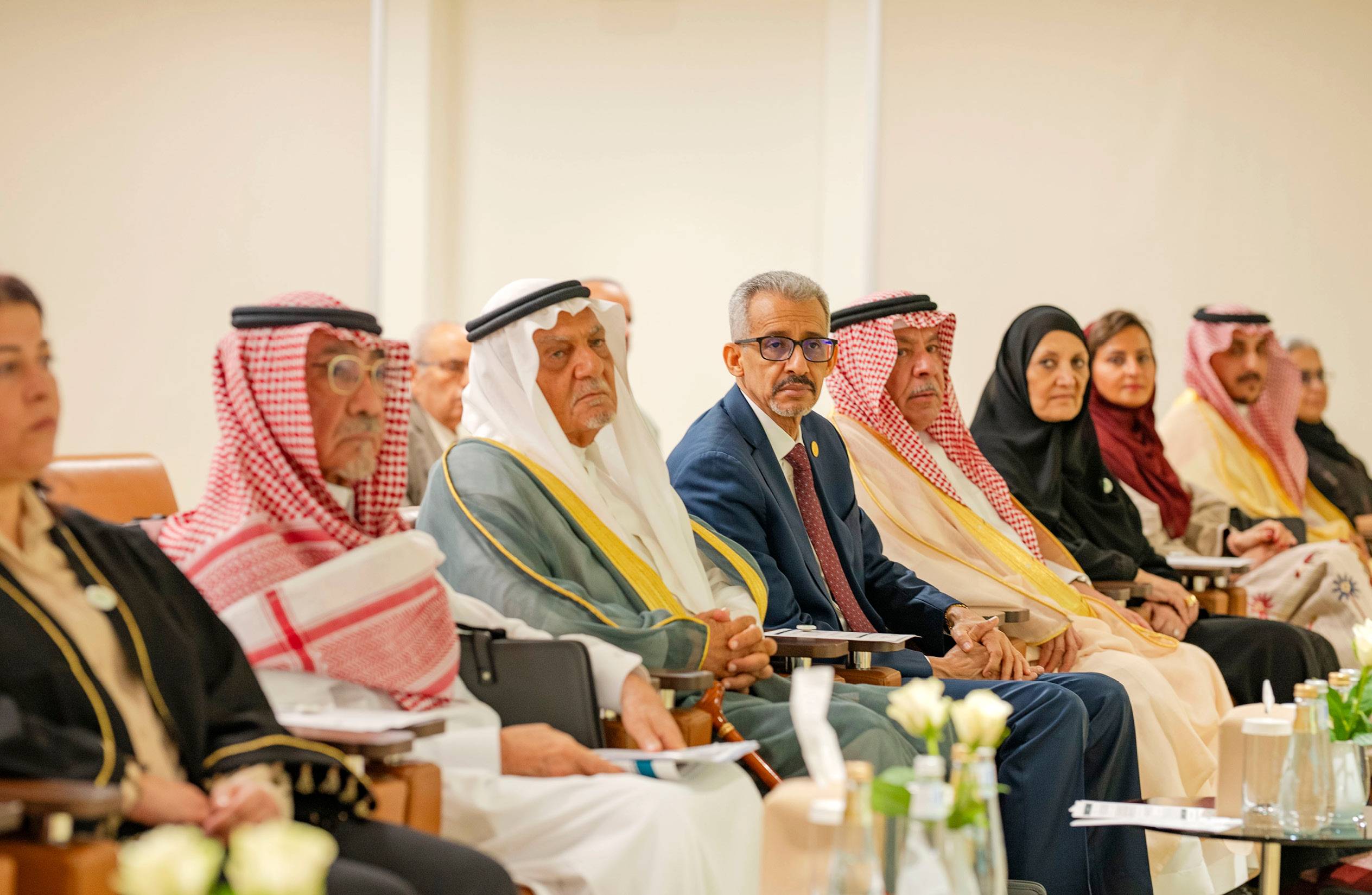
HRH Prince Turki AlFaisal, Chairman of the Board of Directors of the King Faisal Center for Research and Islamic Studies, in the presence of HE Professor Dr. Mohamed Ould Amar, Director General of the Arab League Educational, Cultural and Scientific Organisation (ALECSO), and Her Royal Highness Princess Maha bint Mohammed Al-Faisal, Secretary General of the Centre, the official celebration of Arabic Manuscript Day in its thirteenth session for the year 2025, which was held by the Centre on Sunday, October 5 2025, in cooperation with the Institute of Arabic Manuscripts, under the slogan "Arabic Manuscripts: The Life of a Nation and the Pioneer of Civilisation" at the Centre's headquarters in Riyadh.
In his opening speech, Prince Turki AlFaisal pointed out that this day calls for remembrance of thought, and that the spirit listens to the echoes of centuries, emphasizing that the King Faisal Centre is honored to host the celebration of Arabic Manuscript Day; a day that is not so much about the material as it is about the meaning, immortalizing not the paper but the consciousness with which the identity of the Arab and Islamic nation was written.
HRH added that the center hosting this event is not by coincidence. More than fifty years ago, specifically on the seventeenth of Muharram 1393 AH (February 19, 1973), King Faisal bin Abdulaziz – may he rest in peace – received the delegation of the Institute of Arabic Manuscripts in Riyadh, near the location of the ceremony. This meeting was not a traditional reception, but a flash of thought and a pioneering message in which Faisal illuminated the status of Arab heritage as an authentic source of identity and a constant spring of genuine culture.
HRH pointed out that the then-director of the institute, Dr. Salahuddin Al-Munajjid, documented this historic moment in two immortal volumes. Fate decreed that this history intersect with another achievement when two of the institute's directors, Dr. Hussein Nassar (may God have mercy on him) in 1424 AH, and Dr. Abdullah Al-Ghunaim in 1437 AH, were awarded the King Faisal International Prize. It was as if the prize was a tribute to those who served manuscripts and dedicated their lives to preserving the nation's memory.
At the end of his speech, His Highness commended the generous attention and support given by the Custodian of the Two Holy Mosques, King Salman bin Abdulaziz, and His Royal Highness Prince Mohammed bin Salman bin Abdulaziz, Crown Prince and Prime Minister - may God protect them - to science, knowledge, and the preservation of national, Arab, and Islamic heritage. He emphasized that what King Faisal began five decades ago with the Institute of Arabic Manuscripts is being continued today by his sons and grandsons with a contemporary awareness and genuine cultural commitment, embodying the vision of the wise Saudi leadership to enhance the role of culture and knowledge in the advancement of humanity and society.
For his part, His Excellency Professor Dr. Mohamed Ould Amar, Director General of the Arab Organization for Education, Culture and Science (ALECSO), said that celebrating the Arabic Manuscript Day at the King Faisal Center for Research and Islamic Studies embodies the nation's connection with its civilizational memory and affirms the Kingdom's position as a guardian of Arab culture and a patron of authentic intellectual heritage.
HE added that the Institute of Arabic Manuscripts' selection of the King Faisal Center as a partner in organizing this cultural event is a fitting choice, reflecting the convergence of the two institutions' missions in serving Arab heritage and affirming the Center's pioneering role in enriching the scientific and cultural landscape at both the local and Arab levels.
At the end of his speech, His Excellency Professor Dr. Mohammed Ould Amar expressed his gratitude to the King Faisal Center, HRH Prince Turki AlFaisal, and HRH Princess Maha bint Mohammed AlFaisal, for their warm reception and excellent organization, and for the great efforts they exert in serving Arab and Islamic culture and preserving manuscript heritage. He affirmed that this cooperation embodies the Kingdom's pioneering role in fostering knowledge and preserving the nation's civilizational identity.
Dr. Abdul Rahman Al-Khenifer, advisor to the center, opened the ceremony with a speech welcoming the attendees, emphasizing that Arabic Manuscript Day is an occasion where times and places converge, with Baghdad, Damascus, Cairo and Cordoba reaching out to Dir'iya and Riyadh in a single space celebrating the manuscript. He noted that the King Faisal Centre's hosting of this session is the culmination of a long journey of caring for and preserving Arab heritage, spanning thousands of titles and scientific expeditions that have preserved the life and splendor of Arabic manuscripts throughout the centuries.
During the ceremony, Professor Dr. Yahya Mahmoud bin Junaid from (the Kingdom of Saudi Arabia) was honored as the Personality of the Year for Heritage Research in the Arab world. In his speech during the event, he expressed his happiness with this honor, emphasizing that heritage is not merely a past to be recalled, but a living tool to understand society and the development of intellectual life through the ages. He called for the preparation of a general automated index for heritage books that link their terms and topics according to a precise scientific methodology to facilitate researchers' study and intellectual utilization.
The National Laboratory for the Preservation and Restoration of Parchments and Manuscripts in Kairouan, Tunisia, was also honored as the institution of the year for heritage work in the Arab world. Dr. Manal Ramah, the laboratory's director, expressed her pride in this recognition, emphasizing that it is a crowning achievement for Tunisia and its cultural institutions, and a recognition of the laboratory's leadership in preserving Arabic and Islamic manuscripts, consolidating the nation's cultural identity, and protecting it for future generations.
The book "Jami' Fara'id Al-Milaha fi Jawami' Fawa'id Al-Filaha," edited by Professor Dr. Ihsan Dhanoon Al-Thameri (Iraq), was chosen as the Arab Heritage Book of the Year. Dr. Al-Thameri expressed his pride in this honor on Arabic Manuscript Day, emphasizing that this selection is a recognition of the extensive scholarly effort put into editing the book, which is being published for the first time as an encyclopedic work documenting Arab agricultural heritage and the expertise and knowledge it contains. He pointed out that caring for Arabic manuscripts through preservation, editing, and honoring them is a reverence for our past and an acknowledgment of its greatness among civilizations.
The hosting of this event by the King Faisal Center comes within the framework of its steadfast mission to preserve manuscript heritage and enhance its presence as an integral part of the nation's cultural identity. Since its establishment in 1403 AH / 1983 AD, the King Faisal Center has made the care of manuscripts one of its major priorities, becoming one of the most prominent global references in this field. It has preserved about 30,000 manuscript titles and approximately 150,000 digitized manuscripts photocopied in collaboration with major libraries and museums worldwide. In addition, its achievements in treatment, sterilization, and restoration have extended to include around 330,000 books, manuscripts, and documents, a qualitative addition that confirmed its leadership and highlighted its position as a renewed scientific and cultural platform that transfers this great heritage to future generations.